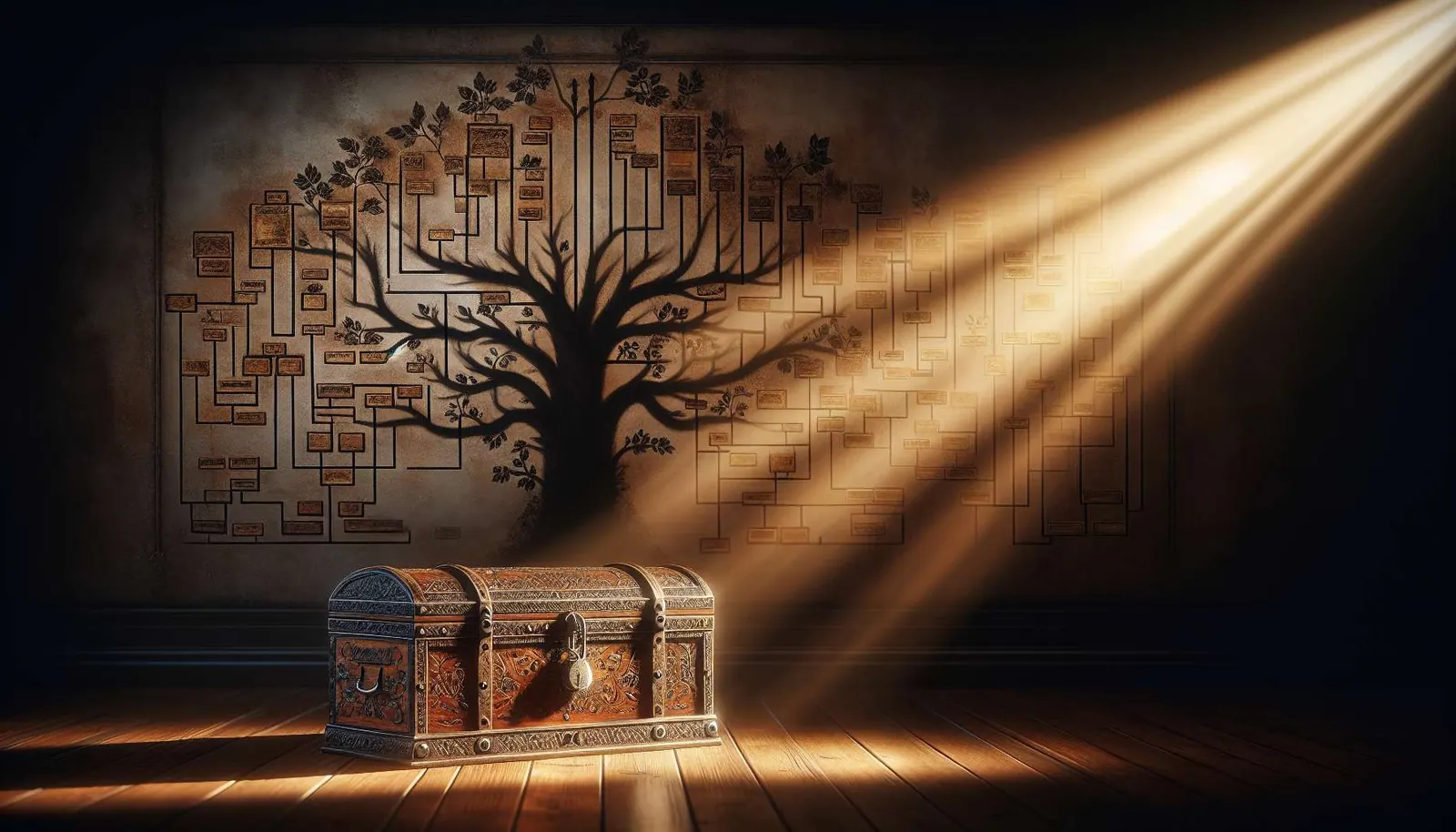
Sometimes a fear, sadness or tension arises in you that you cannot explain. The situation is perfectly ordinary, yet the reaction seems to come from another time. Or you notice that what happened to your parents and grandparents keeps repeating in your own life: the same losses, the same conflicts, the same attitude towards money.
From the perspective of systemic constellations, this is no coincidence. Many personal dilemmas reflect wider, generational themes within the family system. What our ancestors could not work through does not disappear; it is passed on, most often without words and without awareness of it.
In this article you will learn how, according to the teaching of Bert Hellinger and the books Soul Codes and Codes of Success, inherited family traumas are passed down through the generations, and what can help bring that chain into awareness.
The family unconscious: a field that remembers
The book Soul Codes describes three layers of what Hellinger calls the Great Soul: the collective, the family and the individual unconscious. The family unconscious refers to the patterns and energetic contents passed down through the generations within family lines, including customs, beliefs and emotions deeply rooted in family history.
Every family has its own field with a specific informational structure. It holds information about the right to belong, the balance of giving and receiving, and order. This information affects us at an unconscious level, whether or not we know about it.
The Swiss psychiatrist Leopold Szondi, as the same book notes, researched family trees and how traits and experiences are passed from generation to generation. He called this invisible force the family unconscious, while Hellinger called it the Great Soul.
How traumas are passed on
The books describe several pathways. The first is simply closeness and emotional exchange within the family. If we grew up in a family dominated by fear, shame or anger, those emotions may be passed on to us and later affect our relationships and reactions.
The second pathway begins even before birth. During the nine months of pregnancy, the child absorbs information from its surroundings, including energetic influences from the family's past and the thoughts and emotions of the parents at that time. This is how the prenatal unconscious mind is formed.
The third framework, mentioned in the book Soul Codes, is epigenetics: life experiences can influence gene expression without changing the DNA itself, and these ‘switches’ can be passed down through the generations.
Family entanglements are like hidden data or programs in the structure of our being, deeply rooted and passed down through the generations, waiting for the right moment to be activated. (from the book Soul Codes)
When we find ourselves in a situation that is similar to, or resonates with, the inherited experience, that ‘program’ is activated. This is why someone who carries a family burden connected with loss may feel emotions similar to those of their ancestors, even without being directly aware of it.
Unconscious loyalty: the love that binds
Hellinger calls these patterns family loyalties. In the book Codes of Success, unconscious loyalty is described as taking on the emotional expression or stress reactions of parents and other family members, ‘in an attempt to come closer to them or to express love and loyalty towards the family’, or simply because the person does not know any other way.
This loyalty has many faces. The books give these examples:
- unconsciously repeating the behavioural patterns or beliefs of parents and ancestors
- loyalty to family secrets, when true feelings are suppressed in order to preserve the ‘peace’
- identifying with the victim, with a feeling that you do not deserve happiness or success
- taking on the family ‘task’ of putting right things that were never yours
- fear of change, poverty or the unknown, inherited from generations that lived through wars, migrations or great losses
If the previous generation faced great challenges in life, their descendants may take on that emotional burden as part of their inheritance. It then appears as stress in situations that are, even superficially, similar to those their ancestors went through.
Excluded members and the order of love
One of the fundamental principles of Hellinger's classical constellations is the right to belong: every family member has an inalienable right to belong to the system, regardless of their deeds or fate. When someone is excluded or forgotten, for example aborted children or the parents' previous partners, this can create an imbalance that shows itself in later generations.
Constellations often reveal precisely this: unresolved conflicts, secrets or traumas passed down through the generations. When the excluded member is seen again and given their place, space opens for emotional release and for establishing the order of love, in which love flows from the elder to the younger.
How the chain is brought into awareness
The book Soul Codes describes a path in several steps. The first is recognising the hidden patterns, which often happens with the help of a facilitator. Through work with representatives, family dynamics become visible. The book Codes of Success also notes that the process involves acknowledging the burdens and often symbolically returning them to those to whom they truly belong.
After insight comes transformation through systemic self-exploration, and finally the integration of new patterns through presence exercises and ongoing practice. This calls for alertness and patience, because old patterns easily return. It is also important to say this: systemic work does not replace professional psychological or medical help when it is needed.
The legacy of our ancestors is not only a burden. It also carries their strength, talents and love. When you become aware of what is not yours, you can more easily receive what is, and live your own life rather than the continuation of someone else's story.